Most quantitative trading is built on a lie: markets are in equilibrium, returns are Gaussian, linear models are enough. These assumptions hold in the boring middle of the distribution, where nobody makes or loses serious money. They break at the tails, which is where everything interesting happens.
The efficient market hypothesis is not wrong because markets are irrational. It's wrong because markets are complex adaptive systems. Rational agents interacting under imperfect information produce emergent dynamics that no individual agent intended or can predict.
The sandpile and the market
In 1987, Per Bak, Chao Tang, and Kurt Wiesenfeld dropped grains of sand onto a table, one at a time, and measured the resulting avalanches. Most grains did nothing. Occasionally, a single grain triggered a cascade that reshaped the entire pile. The size distribution of avalanches followed a power law — no characteristic scale, no "typical" event, no upper bound.
This is self-organized criticality: complex systems naturally evolve toward a critical state where extreme events are not anomalies. They are the natural output. The system doesn't need a big cause to produce a big effect. A grain of sand can trigger an avalanche. A marginal liquidity withdrawal can trigger a flash crash. The mechanism is the same.
5-sigma events are not once-in-a-lifetime flukes. They are the sandpile doing what sandpiles do. Gaussian Value at Risk is a calculation that assumes the system is a different kind of system than it actually is.
Markets are dynamical systems with feedback
Prices are not independent draws from a distribution. They are the output of a coupled, non-linear, feedback-driven process. Buyers and sellers observe prices, update beliefs, place orders, change prices, which causes other participants to update beliefs and place different orders. The output at time t becomes an input at t+1.
In linear systems, feedback is well-behaved. In non-linear systems, feedback produces regimes, bifurcations, and chaos. Markets are non-linear systems with feedback.
The properties that matter:
- State dependence. A stock at $100 in a calm trend has a different future than the same stock at $100 after a 20% drawdown. Same price, different state, different distribution. Linear models can't tell the difference.
- Phase transitions. Markets don't drift between regimes — they reorganize. The shift from bull trend to liquidation cascade is sudden, discontinuous, and preceded by specific signals: rising correlation, thinning liquidity, increasing skew. The math that describes water freezing describes a market crash.
- Emergence. No trader intends to produce a bubble. Bubbles emerge from thousands of individually rational decisions. The macro pattern is real. It has no author. You cannot understand it by interviewing participants.
- Adaptation. When enough traders adopt a strategy, the strategy changes the market in a way that reduces the strategy's edge. Alpha decay is co-evolution: predator and prey evolve together. What worked yesterday stops working not because it was wrong, but because it was right enough to change the environment.
- Non-ergodicity. The time average of a strategy is not its ensemble average. A strategy with positive expected return can ruin you if you don't survive the drawdowns. In a complex adaptive system, the path you take determines the distribution you sample.
What this means for your trading
The implications are not academic. They change what you build:
Regime detection is the most important problem. Knowing which attractor basin you're in — and detecting the signals of a phase transition — beats predicting the next tick. A mediocre signal in the right regime beats a great signal in the wrong one.
Linear models are components, not systems. PCA, Kalman filters, regression — they have their place. But they belong inside a non-linear wrapper that tells you which regime you're in. The linear model describes what happens inside the regime. The wrapper tells you when the regime changes.
Abandon Gaussian VaR. Use extreme value theory. Model tails with generalized Pareto distributions. Stress-test against power-law cascades, not historical scenarios. The next crash will not look like the last one. It will look like a phase transition.
Treat alpha decay as a dynamical system. It's not erosion. It's a predator-prey model with equilibria, cycles, and extinction regimes. Model it like one.
Backtests are single draws from a non-stationary process. The market of 2018 is not the market of 2026. The participants changed. The attractor basins shifted. A backtest is evidence, not proof.
Quantitative finance borrowed its toolkit from 19th-century physics because those tools produce closed-form solutions, not because they describe markets. Complexity science offers a more accurate description at the cost of fewer closed forms and more simulation. The cost is worth paying.
Markets are not physical systems with fixed laws. They are complex adaptive systems with emergent dynamics. If your trading system doesn't account for this, you are not modeling markets. You are modeling a textbook.
Where to learn this
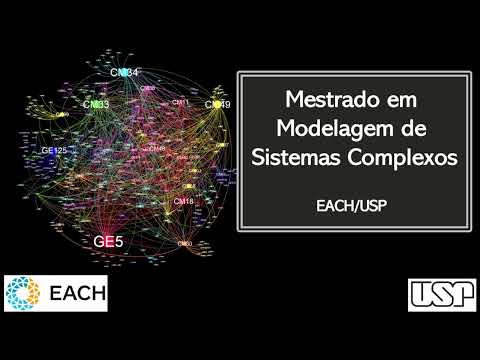
EACH-USP (University of São Paulo) offers a graduate program in Complex Systems Modeling that covers exactly this ground: dynamical systems, agent-based modeling, network theory, and applications to finance. If you trade systematically and want the mathematical foundations this post argues for, it's worth a look.
References:
- Mandelbrot, B. & Hudson, R. (2004). The (Mis)Behavior of Markets: A Fractal View of Financial Turbulence. — The foundational argument that financial markets follow fractal geometry and power laws, not Gaussian random walks.
- Bak, P., Tang, C. & Wiesenfeld, K. (1987). "Self-Organized Criticality: An Explanation of 1/f Noise." Physical Review Letters. — The sandpile model: how complex systems self-organize into critical states where avalanches of any size are the natural output.
- Arthur, W. B. (2014). Complexity and the Economy. — The Santa Fe Institute economist on markets as complex adaptive systems: emergence, non-equilibrium, and why rational agents don't produce equilibrium.
- Peters, O. (2019). "The Ergodiity Problem in Economics." Nature Physics. — Why the time average and ensemble average are not the same, and why that matters for every risk model ever built.
- Taleb, N. N. (2007). The Black Swan: The Impact of the Highly Improbable. — The practical consequences of assuming Gaussian distributions in a fat-tailed world.
- Hamilton, J. D. (1989). "A New Approach to the Economic Analysis of Nonstationary Time Series and the Business Cycle." Econometrica. — The Markov-switching model that introduced formal regime detection to economics.
- EACH-USP. Modelagem de Sistemas Complexos — Graduate program in Complex Systems Modeling at the University of São Paulo.