About 250 years ago, something spectacular happened to the way we make things. We started using machines on a large scale. Mechanization, the division of tasks, the steam engine, the power loom — and the technologies came together in a single physical space where workers operated them in a system of distinct tasks. The factory stood at the center of the Industrial Revolution, and the countries that industrialized surged ahead at a pace never witnessed before. Jostein Hauge, a development economist at Cambridge, opens The Future of the Factory with this history to make a deliberately unfashionable claim:
The main ingredient [in the recipe from poor to rich] has always been the same: industrialization. Countries that have undergone this transformation have strengthened their capabilities in manufacturing and factory-based production. Industrialization has come to be seen as the foundation of technological progress, innovation, international competitiveness, and rapid growth in productivity.
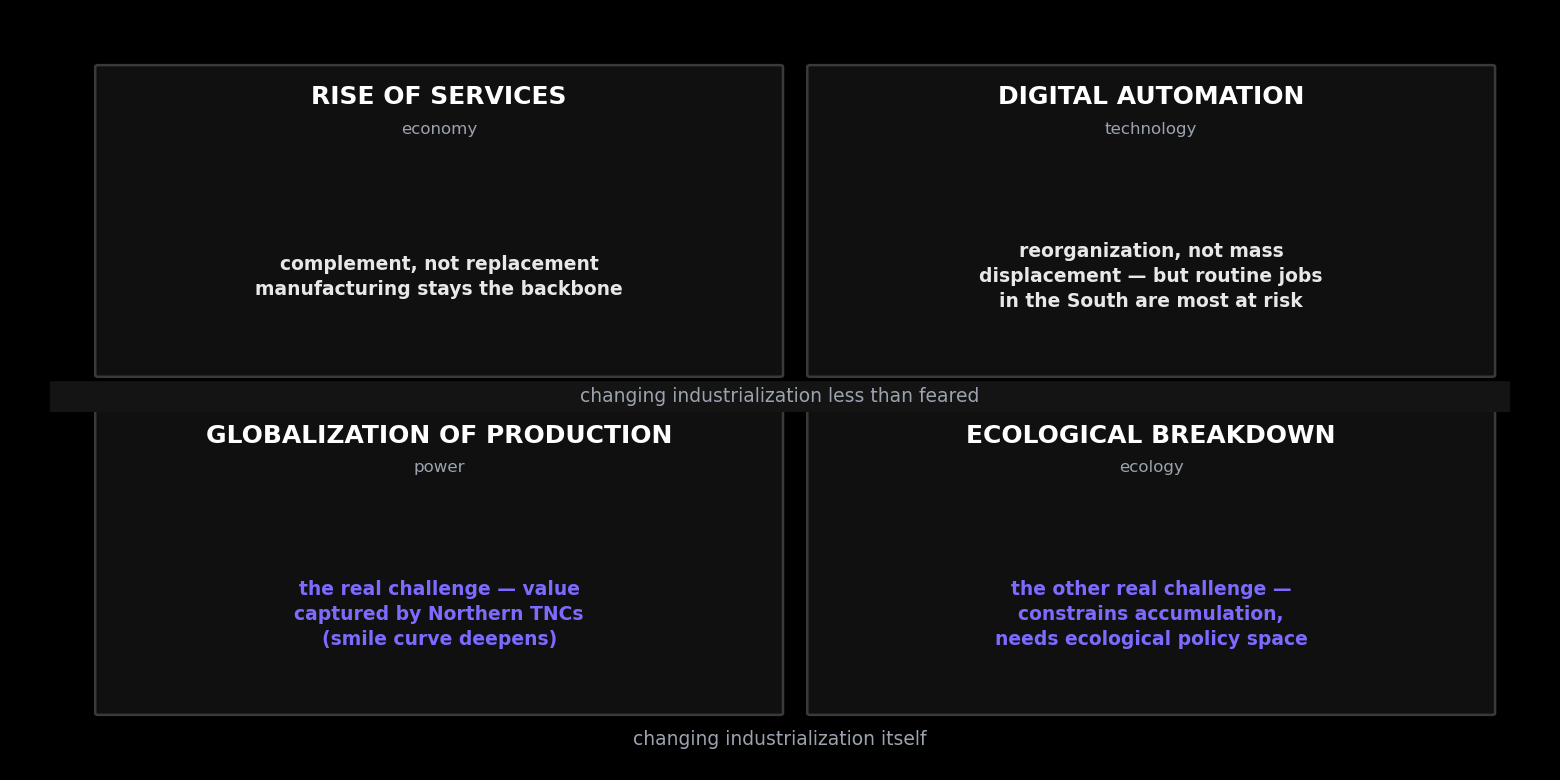
And then the question his book exists to answer: is that still true? "Megatrends" — trends in technology, economy, society, and ecology with global impact — are changing how countries develop, what technological progress means, and whether traditional industrial policy still works. Hauge identifies four that matter, and his verdict on them is the most useful thing in the book: some change industrialization less than people fear, and some change it for real.
The rise of services: complement, not replacement
The first megatrend is a paradox: most of today's "industrialized" countries do not have much industry, measured as a share of output. Services now represent more than sixty percent of world GDP. The world's largest and most profitable companies — Amazon, Google, Walmart — hardly manufacture anything, and even the great manufacturing firms get most of their profits from activities classified as services: research and development, industrial design, retail, marketing. Apple is the world's most valuable manufacturing company and owns essentially no factories. Countries in the global South are riding on service-led growth — India, Kenya, the Philippines, Rwanda.
The conventional reading says this overturns the old model: if services can drive growth, why bother with factories? Hauge's reading is the opposite. The rise of services was driven largely by ICT, which made productivity growth achievable in digital services and made services tradable — the cost of trading services has fallen to the level of trading goods. But services do not replace the manufacturing sector's special properties: the scope for productivity growth, innovation, spillovers, and trade that manufacturing provides to the whole economy. Tapping services for innovation and trade is right; treating them as a substitute for industrialization is a category error. The backbone does not move.
Digital automation: reorganization, not apocalypse
The second megatrend is the one this blog obsesses over: AI and digital automation. The worry is that automation will displace jobs at a pace not seen before, and that manufacturing-led growth is therefore dead as a development strategy. Hauge's reading is more historical. For decades, computer-based automation was limited by the need to codify every operation — it struggled with abstract thinking, manual adaptability, situational awareness. AI relaxes that constraint, but the historical pattern of technological change has been reorganization of the labor force rather than mass displacement: machines eliminate some tasks, create others, and change the skills in between. The fourth industrial revolution, he insists, is not a fourth industrial revolution — it is continuing developments in digital technologies.
There is a genuine concern buried in the reassurances, and it is the one that matters for development: studies consistently find that jobs in the global South are at higher risk of automation than jobs in the global North, precisely because routine manufacturing jobs are the most automatable. The reorganization will not be distributed evenly. The countries that industrialized on labor-intensive manufacturing — the classic late-development path — are the ones whose comparative advantage automation targets first. The factory is not dying, but the specific deal that let East Asia industrialize — cheap labor doing routine assembly — is a deal whose terms are expiring. This blog's own evidence base makes the point at the level of individual workers: the trial covered in You Don't Learn What You Delegate found programmers who delegated their learning scored 17% lower on what they were supposed to learn. Automation does not merely replace the task; it can remove the learning the task used to provide.
Globalization of production: the real challenge
The third megatrend is where Hauge's argument sharpens from contrarian to critical. Production systems have become globally fragmented: tasks and activities dispersed across networks of firms in many countries. The iPhone is "made" by Apple, which owns no factories of consequence; the parts come from Japan, South Korea, and Taiwan — Toshiba, Samsung, Intel, Sony, SK Hynix, LG, Qualcomm — and the assembly happens in China, performed by Taiwanese contract manufacturers like Foxconn. Complex value chains like this now produce practically all the stuff consumed in the global North. And despite the deglobalization headlines of the post-COVID, post-Ukraine era, the globalization of production is still going strong.
The consequences are not neutral. Global value chains exacerbate power asymmetries in the world economy in favor of the transnational corporations that govern them, and they squeeze profit margins for the workers, firms, and countries at the bottom of the chain.
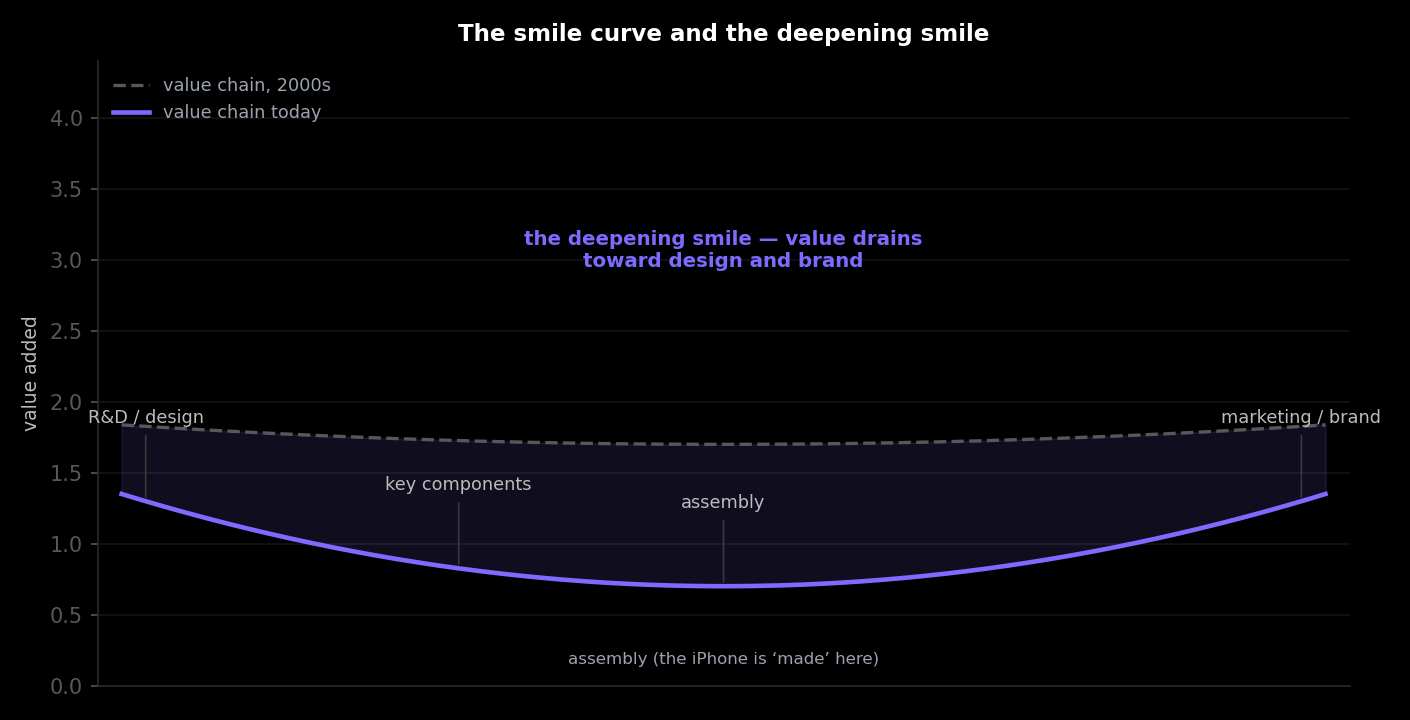
The smile curve makes the structure visible: value added is high at the ends of the chain — R&D, design, branding — and low in the middle, where assembly happens. And the smile is deepening: the ends are capturing more, the middle less. Assembly is where the global South sits in the chain, and its share of the value is falling. The globalization of production is not the neutral spread of opportunity its promoters promised; it is a structure of governance in which the rules favor the rule-setters. This is the megatrend that genuinely makes traditional industrialization harder — not because factories are obsolete, but because the value they capture is being concentrated at the design and brand ends of the chain, which are not where late industrializers start.
Ecological breakdown: the other real challenge
The fourth megatrend is the one most development economics ignores and the one Hauge insists must be faced. We are living in an age of ecological breakdown: climate change, driven mainly by the emission of greenhouse gases in energy use, plus the quieter plunder of the planet's resources — biomass, fossil fuels, metals, non-metallic minerals. Even if the world fully decarbonized, that would do little to reverse deforestation, soil depletion, overfishing, unsustainable extraction, and mass extinction, which have more to do with the constant growth in material output than with the carbon content of energy.
The uncomfortable implication is that industrialization and ecological sustainability may be in tension. The countries that industrialized first got there by burning the planet's budget; the countries that want to industrialize now face the bill. Hauge's proposal is not to deny the tension but to discuss it honestly, including the possibility of giving some countries more "ecological policy space" than others, given how unequal national responsibility for ecological breakdown is. The global North caused the breakdown; the global South bears the worst of its impact, and the constraint falls hardest on the accumulation and productivity growth that late industrialization requires.
Power and politics over technology
The book's core contribution is the lens, not the list. Hauge deliberately analyzes the megatrends not only through mainstream economics but through heterodox economics, political economy, innovation studies, sociology, and political ecology — and the conclusion that falls out is that power asymmetries in the world economy have as much, if not greater, impact on industrialization pathways than new technologies in and of themselves.
That is the sentence worth taking seriously in the age of AI. The dominant framing of technological change is technological: models improve, automation spreads, productivity rises, and countries adapt. Hauge's framing is political: the question is not only what the technology can do, but who governs the chain, who sets the rules, who owns the design end of the smile, and who is left with assembly. The same lens this blog has applied to AI — who owns the compute, who captures the value, who sets the rules of the agent economy — is exactly the lens Hauge applies to manufacturing. The factory is a governance structure as much as a production structure, and it has always been.
Industrial policy for the future
Which is why his final chapter is about industrial policy, not technology. If power shapes industrialization, then the state's role is not optional. Hauge charts pathways for a new industrial policy: targeted, capability-building, willing to use the full instrument set — not the generic "improve the business climate" advice that dominated the last era of development orthodoxy. And it must operate in the ecological space: industrial policy that ignores the planetary budget is designing for a world that no longer exists. The future factory, in his conclusion, is not the factory of robots replacing everything; it is the factory remade — cleaner, more automated, embedded in value chains whose governance is contested rather than assumed, and still the place where countries build the capabilities that prosperity is built on.
The software factory
The book is about physical manufacturing, and it is worth ending by pointing the lens at the next factory. The software industry has already industrialized: code is produced in factories — the dark factories this blog has documented, where agents take specs in and software comes out. Apply Hauge's four megatrends to the software factory and the pattern repeats almost exactly.
The term itself is older than the AI era, and its history carries the same pattern. "Software factory" appears explicitly in the official report of the 1968 NATO Software Engineering Conference in Garmisch (7–11 October 1968), where Robert W. Bemer's working paper Machine-controlled production environment was described as the most ambitious tooling proposal presented — Bemer called it a "machine-controlled production environment, or software factory." His factory was supposed to provide a controlled environment in which program construction, testing, and use occurred: a file system, compilation, test-system construction, final-system building and distribution, documentation, software indexes, dependency graphs, quality control, instrumentation, scheduling, and costing. The Computer History Museum's archive of Bemer's papers describes the 1968 contribution as the "First design document for a Software Factory."
One historical qualification: saying the term was coined at NATO in 1968 is slightly stronger than the evidence warrants. Bemer had been developing this production-oriented thinking before the conference — the same NATO report reproduces his Checklist for planning software system production, explicitly dated August 1966. The safer statement is that the software factory concept received one of its earliest explicit and detailed formulations from Robert W. Bemer at the 1968 NATO Software Engineering Conference.
And the same conference contained M. D. McIlroy's famous argument for mass-produced, reusable software components. So 1968 already contains the two ideas that later become central to software industrialization: factory-controlled production and reusable components. The dark factory era is recombining exactly those two poles — agents as the interchangeable production machinery, prompts and skills as the components.
- The rise of services — software's answer to "manufacturing is dying" is SaaS and AI-as-a-service: the product becomes the service, and the firms that win capture the service end of the value chain. The backbone doesn't move; it becomes invisible.
- Digital automation — agents automate the routine work of software production, and the risk concentrates exactly where Hauge says it does: the routine jobs of the global periphery, which is why the offshore software industry is the first to feel it.
- Globalization of production — the software smile curve is as deep as the hardware one. The assembly — the code — is written wherever labor is cheapest; the value is captured at the ends: data, compute, distribution, and brand. The "AI colony" dynamic this blog has written about is the deepening smile applied to models: the South provides the data and the labor, the North owns the platform.
- Ecological breakdown — AI's constraint is no longer only labor but energy: training and inference have a material footprint, and the same question Hauge poses for steel applies to GPUs.
The pattern is the proof of the thesis. Industrialization is not over; it is being remade, and the countries that will matter in the next era are the ones that treat the new factory — the software factory, the AI factory — as a place to build capabilities in, rather than a place to rent labor to. The factory is not dead. It is being rebuilt, and the question is who builds it, who owns it, and who gets the design end of the smile.
References:
- Jostein Hauge. The Future of the Factory: How Megatrends are Changing Industrialization. Oxford University Press, 2023. — the four megatrends, the smile curve, and the case for a new industrial policy. Quotes and figures in this post are drawn from the book's introduction (Chapter 1) and figures 4.3 and 5.1.
- Jostein Hauge. How the West Was Won and Where It Got Us, 2020. — the earlier book on globalization and the myth of free trade.
- Related: AI sovereignty or AI colony: why domestic capability matters — the deepening smile applied to AI: data and labor in the South, platforms in the North.
- Related: AI Sovereignty Is Freedom — capability-building as the industrial policy of the AI era.
- Related: Software dark factories: specs in, software out — the software factory Hauge's lens applies to.
- Software Engineering: Report on a Conference Sponsored by the NATO Science Committee (Garmisch, 7–11 October 1968) — Bemer's Machine-controlled production environment ("or software factory") and his August 1966 Checklist for planning software system production; McIlroy's mass-produced software components.
- Published Papers of Robert W. Bemer (Computer History Museum archives) — describes the 1968 contribution as the "First design document for a Software Factory."
- Related: The economics of the dark factory: what happens when code is free — automation reorganizing the software labor force.
- Related: You Don't Learn What You Delegate — what automation removes when it replaces the task.
- Related: Hangzhou AI City — a regional industrial policy for the AI factory in practice.
- Related: UAE Sovereign AI: First, Train the Humans — capability-building before capability-having.
- Related: Plano Brasileiro de Inteligência Artificial (PBIA) — a late industrializer writing industrial policy for the AI era.
- Related: Every Token Has a Price Tag — the metered input cost of the new factory.