In January 2026, Anthropic shipped Claude Cowork — a desktop AI agent that could read your files, send your emails, and manage your calendar. It cost $100 per month as part of the Max plan. Within forty-eight hours, an independent developer had built a free, open-source clone using AI-assisted coding. The clone was crude. It demonstrated something real: the desktop agent category was legible enough to be replicated in a weekend by one person with an LLM. The barrier to entry was not the technology. It was the distribution, the integration surface, and the trust model.
Six months later, Andrew Ng released OpenWorker. It is not a weekend clone. It is a fully architected open-source desktop agent, MIT-licensed, with twenty-five tool integrations, four pre-built personas, a local Python agent engine, a Tauri desktop shell, and a unified LLM library called aisuite underneath. It runs on macOS and Windows. It ships as a signed, notarized DMG with auto-update. It is free. You bring your own API keys. Your data stays on your machine.
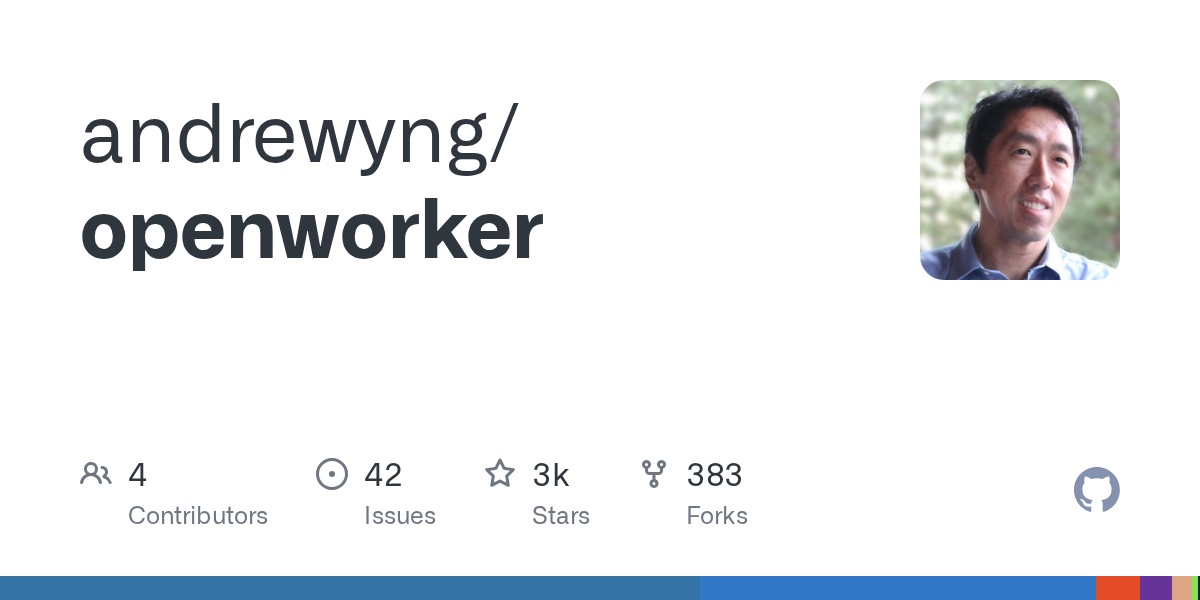
OpenWorker is not an answer to Claude Cowork. It is an answer to the question of whether the desktop agent layer will be owned by model providers or by users. The question is not settled. OpenWorker is the strongest argument yet for the user's side.
What it is
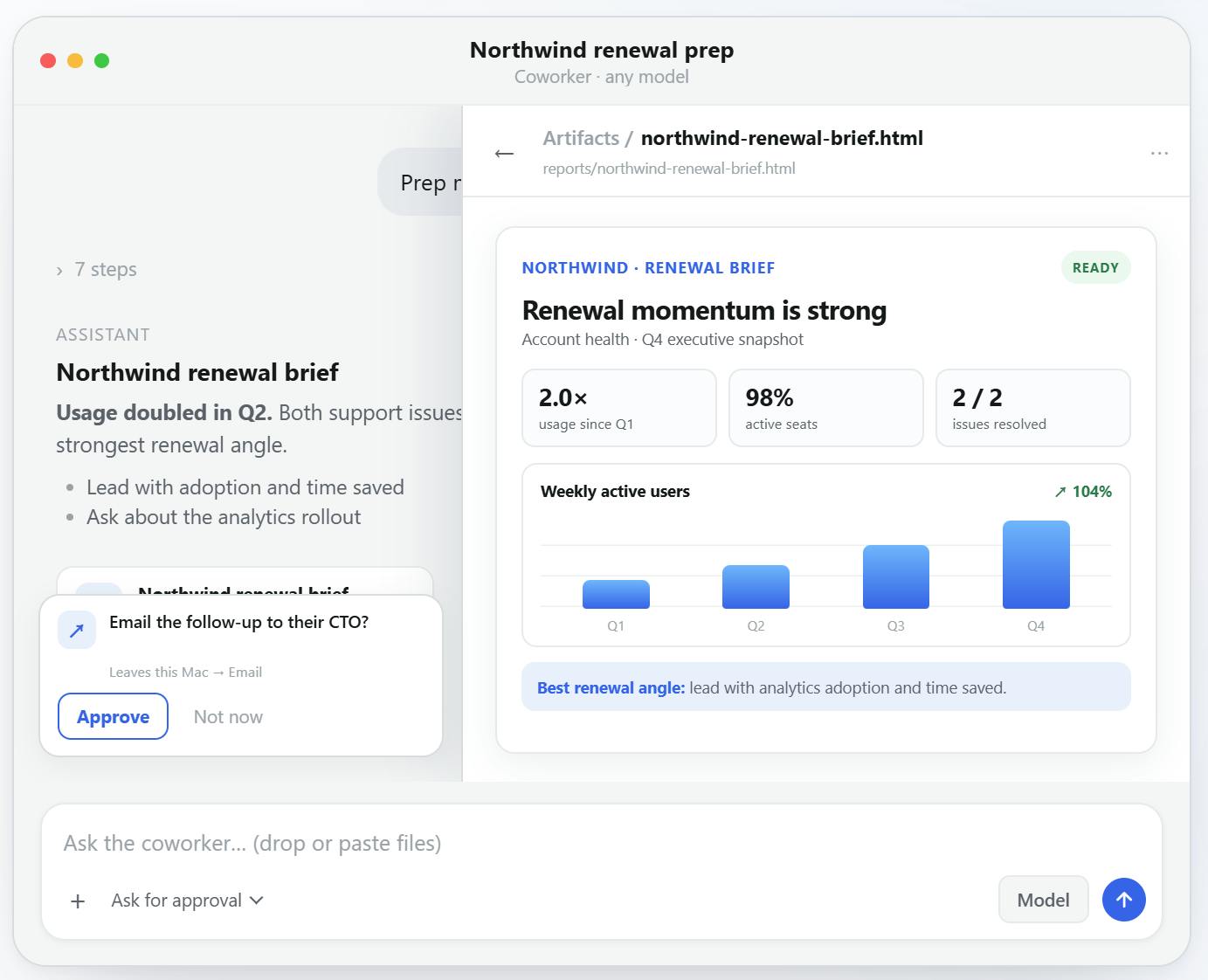
OpenWorker is a desktop application that takes a desired outcome — "prepare a renewal brief for the Acme account," "untangle my calendar for Thursday," "check the release status across Jira and GitHub and draft a status update" — and produces a finished deliverable. Not a chat transcript. Not a suggestion. A completed document, a sent message, a resolved calendar conflict, a structured report with embedded data from multiple sources.
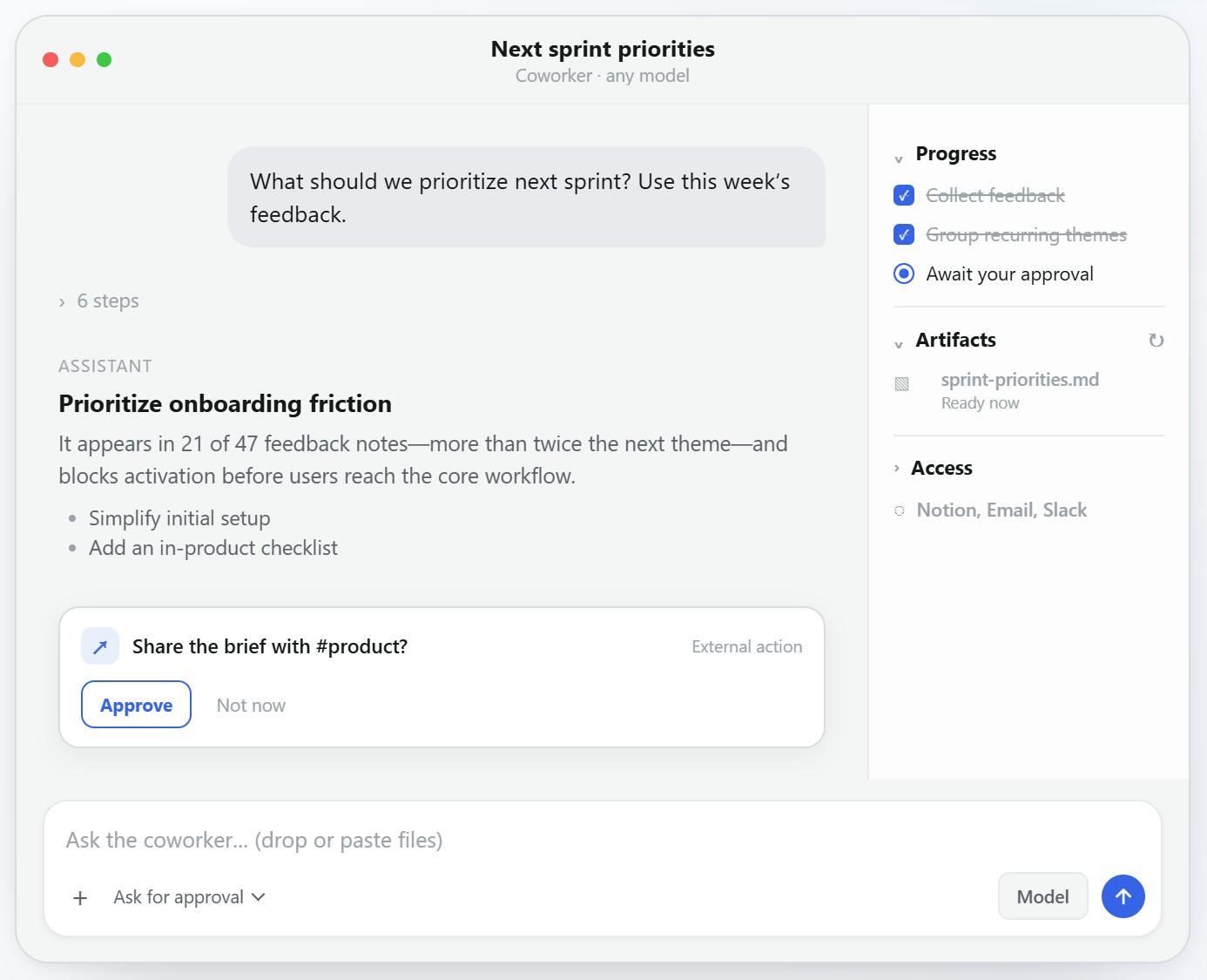
The workflow has four steps: the user states an outcome; the system decomposes the request into steps and works across the user's files, terminal, and connected tools; it pauses for approval before any consequential action (sending, writing, shell execution); and it delivers finished work.
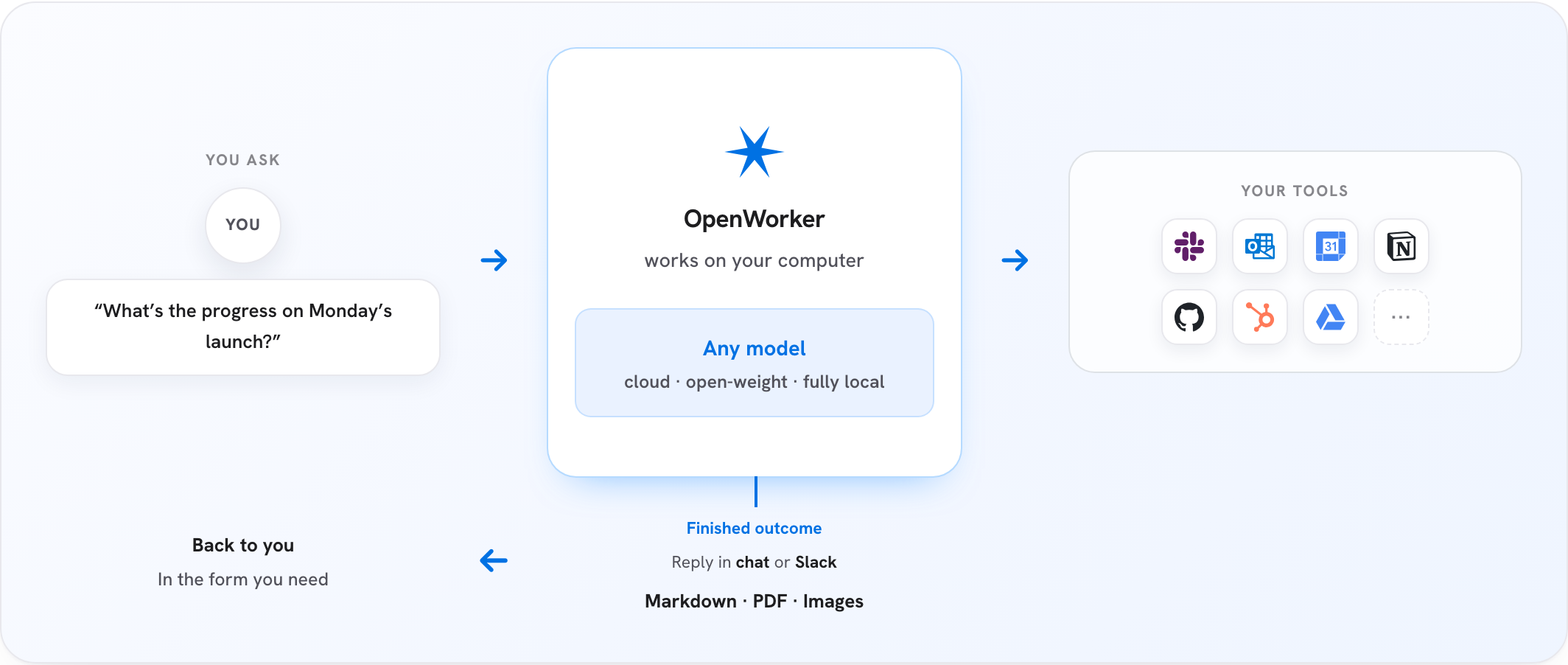
The architecture is layered. At the top, a Tauri shell wraps a React interface — a native desktop application with local state. In the middle, a Python agent server handles the agent loop, tool execution, model dispatch, and MCP connections. At the bottom are the local resources: the user's files, terminal, model API keys, and OAuth tokens for twenty-five external services, all stored in the local secret store.
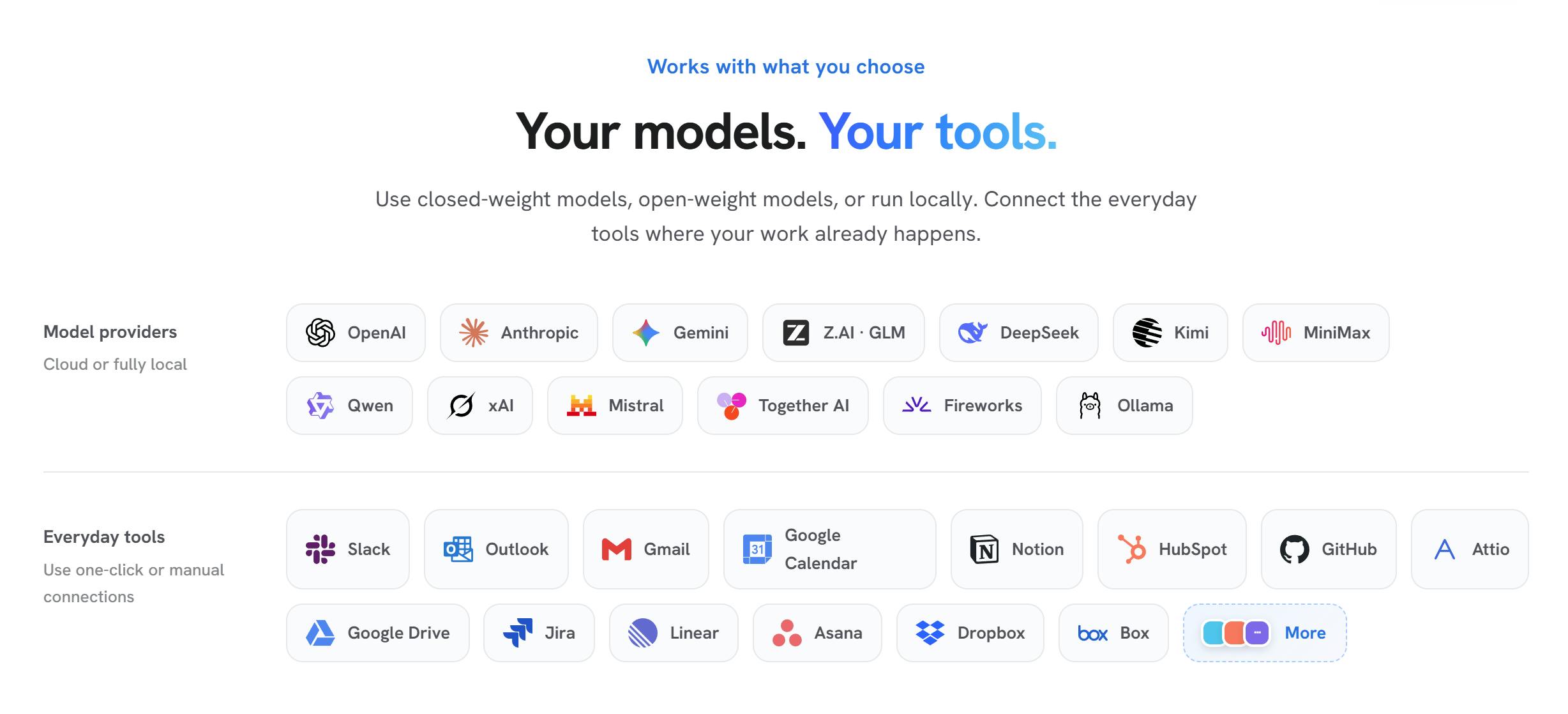
The engine is built on aisuite, Ng's open-source Python library that provides a unified chat-completions API across every major LLM provider — OpenAI, Anthropic, Google, DeepSeek, Mistral, Grok, and more — plus fully local models through Ollama. aisuite is twelve thousand lines of the kind of unglamorous infrastructure code that makes everything else possible. It normalizes provider differences, handles tool calling with automatic schema generation, supports MCP servers natively, and provides agent toolkits for files, git, and shell. OpenWorker inherits all of this. The provider string anthropic:claude-sonnet-4-6 works the same as openai:gpt-4o works the same as ollama:llama3. The user switches models mid-conversation if they want. The agent does not care.
The personas
OpenWorker ships with four pre-configured personas, each with specific tool connections and approval gates:
- Sales: Connected to HubSpot, email, and calendar. Researches accounts, synthesizes CRM history with customer threads, produces renewal briefs with actionable recommendations. The kind of preparation work that takes a salesperson two hours of context-switching across tabs and produces a document a manager skims in ninety seconds.
- Executive Assistant: Connected to email, calendar, and Slack. Triages inboxes, resolves meeting conflicts by checking attendee availability and room bookings, drafts reschedule communications, protects calendar blocks. The delegated cognitive load of schedule maintenance, which is not cognitively demanding and is cognitively exhausting.
- Marketing: Connected to HubSpot, GA4, and Slack. Tracks campaign performance, attributes spend, produces structured reports. The analytics assembly work that marketing teams either do poorly or pay consultants to do adequately.
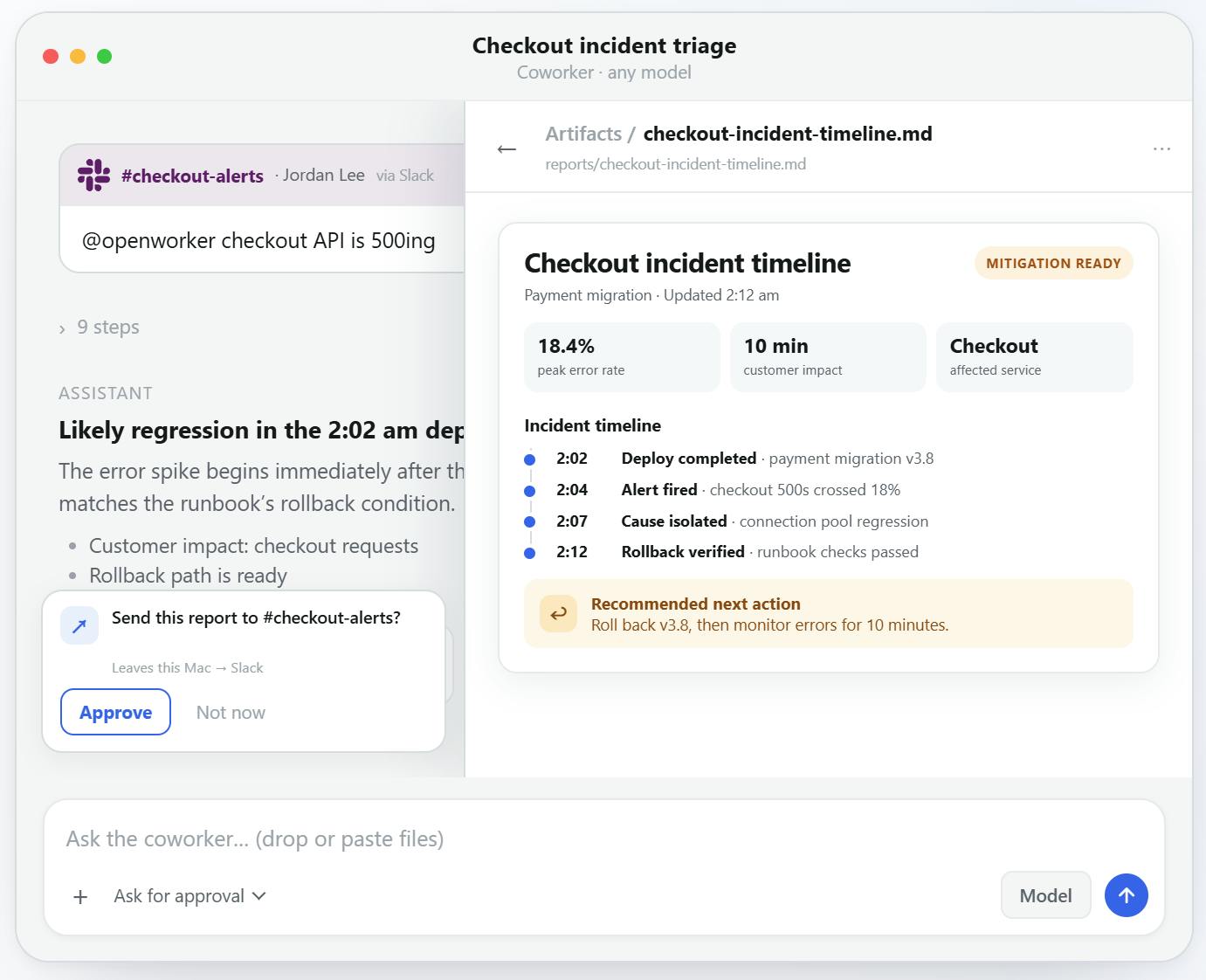
- Ops On-call: Connected to Slack, PagerDuty, and GitHub. Inspects recent deploys, cross-references runbooks, drafts incident timelines, proposes rollback actions. The first fifteen minutes of incident response, automated.
Each persona is a configuration, not a separate product. The persona system is extensible — users define their own with the same skill and tool definitions the built-in personas use. The personas are interesting not because they are good but because they are explicit. They name the domains where an AI agent operating across tools produces more value than an AI chatbot operating in a text window. Sales, scheduling, marketing analytics, incident response. The common thread is cross-tool synthesis. Each persona's value comes from the fact that the information needed to do the job lives in three different applications, and a human currently does the integration manually.
The personas are not the product. They are demonstrations of the thesis. The thesis is that work which requires integrating information across tools — Slack plus calendar plus email plus CRM — is work an agent can do faster than a human, provided the agent can reach the tools. The open question is whether the integration surface stays open.
Why the architecture matters
OpenWorker's architecture encodes decisions that are easy to get wrong. Each is a bet on how the desktop agent layer will evolve.
Local-first. Conversations, credentials, model keys, and the agent loop all run on the user's machine. Data leaves the device only through explicitly chosen model providers and integrations. There is no cloud dependency for core function. The only cloud service is an OAuth brokering endpoint for connector authentication — Slack and Google require server-side OAuth flows — and even this can be bypassed by providing manual API keys. The bet is that users and enterprises will demand agents that don't send their files to a provider's cloud. The bet is plausible for the same reason the bet on local LLM inference is plausible: data gravity, regulatory pressure, and the structural advantage of running the agent where the data already lives.
Model-agnostic. The engine does not prefer any provider. The provider string is a parameter. The user chooses the model and can switch mid-task. This is not merely convenient. It is a structural defense against provider lock-in. If Anthropic raises prices or changes terms, the user moves to OpenAI. If OpenAI degrades, the user moves to Google or DeepSeek or a local model. The switching cost is zero. The agent works the same regardless of which provider's API key is in the config. The bet is that the model layer is commoditizing and the agent layer should not be coupled to it. The bet is correct in proportion to how fast models improve relative to each other — which is to say, the bet is correct.
Approval-gated. Any action that writes, sends, or executes requires explicit user approval. The agent checks in before sending an email, posting to Slack, modifying a calendar, or running a shell command. For scheduled automations that run unattended, approval requests are parked in an inbox rather than executed autonomously. The approval gate is a design pattern, not a feature. It separates the agent into two modes: research and drafting (autonomous, safe) and execution (gated, human-in-the-loop). The pattern is not novel — it is the architecture every production agent system converges on — but shipping it as a default rather than an afterthought is a statement about what kind of agent this is.
MCP-native. Any tool reachable via the Model Context Protocol can be plugged into OpenWorker with per-tool access control. This means the integration surface is not limited to the twenty-five connectors Ng's team built. Any MCP server — filesystem, database, API wrapper, proprietary internal tool — becomes an OpenWorker tool. MCP is the USB-C of agent-tool interfaces. OpenWorker treats it as a first-class citizen because the bet is that the tool ecosystem will grow faster than any single team can integrate, and the agent that can reach the most tools wins.
The competitive landscape
OpenWorker enters a field that has been forming rapidly since the beginning of 2026. Three positions are now visible:
Claude Cowork (Anthropic, January 2026): The first mover. A desktop agent wrapped around Claude Code, aimed at non-technical knowledge workers. $100 per month as part of the Max subscription, tied to Anthropic's models. The simplest experience. The most constrained: no model choice, no Slack integration, no scheduled automations. Activity is excluded from Anthropic's Compliance API, which makes it problematic for regulated organizations. The bet is that most users want the simplest thing and will pay for it.
Codex Desktop (OpenAI, February 2026): The enterprise play. Multi-agent orchestration with sandboxed parallel execution, an in-app browser, and admin-enforced policies that users cannot weaken. Covered by OpenAI's Compliance API. Built on the open-source Codex CLI (Apache 2.0). Tied to OpenAI models. The bet is that organizations with compliance requirements will pay a premium for auditability and centralized control.
OpenWorker (Andrew Ng, July 2026): The open play. Free, MIT-licensed, model-agnostic, local-first. Adds capabilities neither proprietary option offers: Slack triggers, scheduled automations, cross-tool personas, full MCP extensibility. Available on GitHub, openworker.com, and Product Hunt. The bet is that a sufficient number of users and organizations want an agent they control, running on their machines, with their keys, connected to their tools, and modifiable at the source level.
The fork is between the platform model and the tool model. In the platform model, the agent is a service you subscribe to. The provider chooses the model, stores the state, and sets the terms. In the tool model, the agent is software you run. You choose the model, you store the state, and the terms are the MIT license. OpenWorker is the tool model's most serious entry.
The fork is not hypothetical. It is the same fork that played out between Google Docs and Emacs, between Salesforce and self-hosted CRMs, between every SaaS product and its open-source alternative. The SaaS product wins on convenience. The open-source alternative wins on control, cost, and extensibility. Both survive. The question is the ratio.
The Ng variable
Andrew Ng's involvement changes the dynamics. Ng co-founded Coursera, founded Google Brain, was chief scientist at Baidu, and now runs DeepLearning.AI. He is the most effective educator in the history of machine learning. His courses have trained more AI practitioners than any other resource. When Ng releases an open-source project, it gets distribution through his network in a way that a random GitHub repo does not. aisuite has twelve thousand stars. OpenWorker will likely surpass that.
Ng's strategic pattern is visible: build infrastructure (aisuite), then build applications on top of it (OpenWorker). The infrastructure is a unified LLM interface that abstracts providers. The application is a desktop agent that uses the infrastructure. Both are MIT-licensed. Both are model-agnostic. Both are designed to be forked, modified, and embedded. The pattern is not "build a product and charge for it." The pattern is "build a commons and let an ecosystem form around it."
Ng's bet is that the desktop agent layer will be won by the most open option, not the most polished one. It is the same bet he made with Coursera — that open access beats gated access over a long enough time horizon. The bet has paid out before. It may again.
What it means
OpenWorker matters for four reasons, none of which depend on whether it succeeds as a product.
First, it validates the desktop agent as a category. When the most prominent educator in AI ships a free, open-source entry into a category, the category is real. Claude Cowork proved the category could be built. OpenWorker proves the category can be built without a $100 subscription, without a model provider's permission, and without sending your data to someone else's cloud. The category is now contested. Contested categories attract investment, talent, and attention. The category accelerates.
Second, it establishes model-agnosticism as a viable architectural principle for agents. Most agent products are tied to a single model provider — Cowork to Anthropic, Codex to OpenAI. OpenWorker demonstrates that an agent can be built on a unified LLM interface and work correctly across providers. If the model layer is commoditizing — and every week brings new evidence that it is — then coupling your agent architecture to a single provider is technical debt. OpenWorker shows what the alternative looks like in production.
Third, it makes the approval-gate pattern a default. Agents that act autonomously on a user's behalf are a trust problem. The solution is not to make the agent smarter. It is to make the agent ask permission before it does anything consequential. OpenWorker ships this as a default, not a setting. The pattern will generalize. The agents that ship without it will cause incidents. The incidents will make the pattern mandatory.
Fourth, it draws a line between the platform model and the tool model at the desktop agent layer. The platform model says the agent is a service. The tool model says the agent is software. The platform model wins on convenience. The tool model wins on control. OpenWorker is the tool model's strongest entry. If it gains traction, it forces the platform providers to compete on openness. If it doesn't, the desktop agent layer consolidates into two proprietary stacks. Either outcome is worth watching.
The desktop agent is the first genuinely new interface layer since the smartphone. Who controls it — platform providers or users — will determine who captures the economic value of the work it automates. OpenWorker is an argument that the answer should be: the user. The argument is now in code. The code is on GitHub. The rest is distribution.
References:
- Ng, A., & Prasad, R. (2026). OpenWorker — open-source desktop AI agent, MIT license. GitHub: andrewyng/openworker. Product Hunt. Downloads (macOS Apple Silicon) and Windows.
- Ng, A. (2025). aisuite — Simple, unified interface to multiple Generative AI providers. MIT license. 12,000+ GitHub stars. The infrastructure layer under OpenWorker: unified chat-completions API, agent toolkits (files, git, shell), native MCP support, provider abstraction across OpenAI, Anthropic, Google, AWS Bedrock, Mistral, DeepSeek, Ollama, and more.
- Anthropic (2026). Claude Cowork — proprietary desktop AI agent, included in Max subscription at $100/month. The first mover in the category. Note: Cowork activity is not covered by the Anthropic Compliance API.
- OpenAI (2026). Codex Desktop — proprietary desktop agent with sandboxed multi-agent orchestration, enterprise compliance controls, and in-app browser. Built on the open-source Codex CLI (Apache 2.0). Covered by OpenAI Compliance API.
- different-ai (2026). OpenWork — open-source Cowork alternative, originally built in 48 hours after Cowork's launch, later developed as a full product. YC-backed. MIT license. Distinct from Ng's OpenWorker — note the spelling.
- Model Context Protocol (MCP) — Anthropic's open standard for connecting AI agents to external tools and data sources. Specification. OpenWorker, aisuite, Claude Code, and Codex CLI all support it natively.
- Ollama — run LLMs locally. OpenWorker supports fully local operation via Ollama, with no API keys or network calls required for inference.
- Jamilxt (2026). "Andrew Ng's OpenWorker: An Open-Source Desktop AI Agent." dev.to. Early community coverage with architecture breakdown.
- OpenWorker localization (zh-CN) — community Chinese translation, with additional UI screenshots.