dic.mcit.gov.qa is the home of Qatar's Digital Incubation Center (DIC) — the startup incubator run by the country's Ministry of Communications and Information Technology (MCIT). Its pitch, as of the 2025 snapshot of its own homepage, is short: "0% Equity. 100% Enablement."
That claim is the most important fact about the program. DIC does not take equity, it does not charge for its services, and AI is one of its named focus areas. That makes it a genuinely unusual on-ramp for AI startups: a government-funded, free, no-dilution incubation program in a Gulf state that is spending seriously on becoming an AI hub.
What the DIC is
The Digital Incubation Center is Qatar's national incubator for technology startups. It has been operating since the mid-2010s — its first intake of young entrepreneurs was announced for 2016 — originally under the Ministry of Transport and Communications, which later became MCIT. Its own words, from the 2023 snapshot of the site:
The Digital Incubation Center (DIC) was created to boost ICT innovation in Qatar, particularly among young people at the critical early stages of starting or growing a technology-related business. ... We offer startups free office space, technical support, training and guidance, mentors who can help new businesses avoid the typical start-up pitfalls...
It is funded by the state, takes no equity, and receives no payment for its services — all confirmed in the incubator's own FAQ. The homepage counters, identical in the March 2023 and May 2025 snapshots, tell the scale story:
| Metric | Value |
|---|---|
| Startups incubated | 160 |
| Jobs created | 614 |
| Successfully graduated | 76 |
| Applications received | 1,650+ |
| Current startups | 60 |
| Total investment (counter) | 205.4M |
| Average investment per startup per year | 3.614M |
Read the counters as directional marketing, not audited statements — and do the arithmetic once before you plan around them. "Total investment" (205.4M) divided by "average per startup per year" (3.614M) is ≈ 57, almost exactly the 60 "current startups": the "total" is a snapshot of roughly the current cohort, not a cumulative figure since 2016. Jobs work out to ≈ 4 per startup, and 76 graduates of 160 incubated is a 47% graduation rate — real, but small-team, incubation-scale. The currency is almost certainly the Qatari Riyal (pegged at 3.64 to the dollar), which puts the headline 2019 matchmaking event at QAR 22.6M ≈ US$6M.
The program funnel
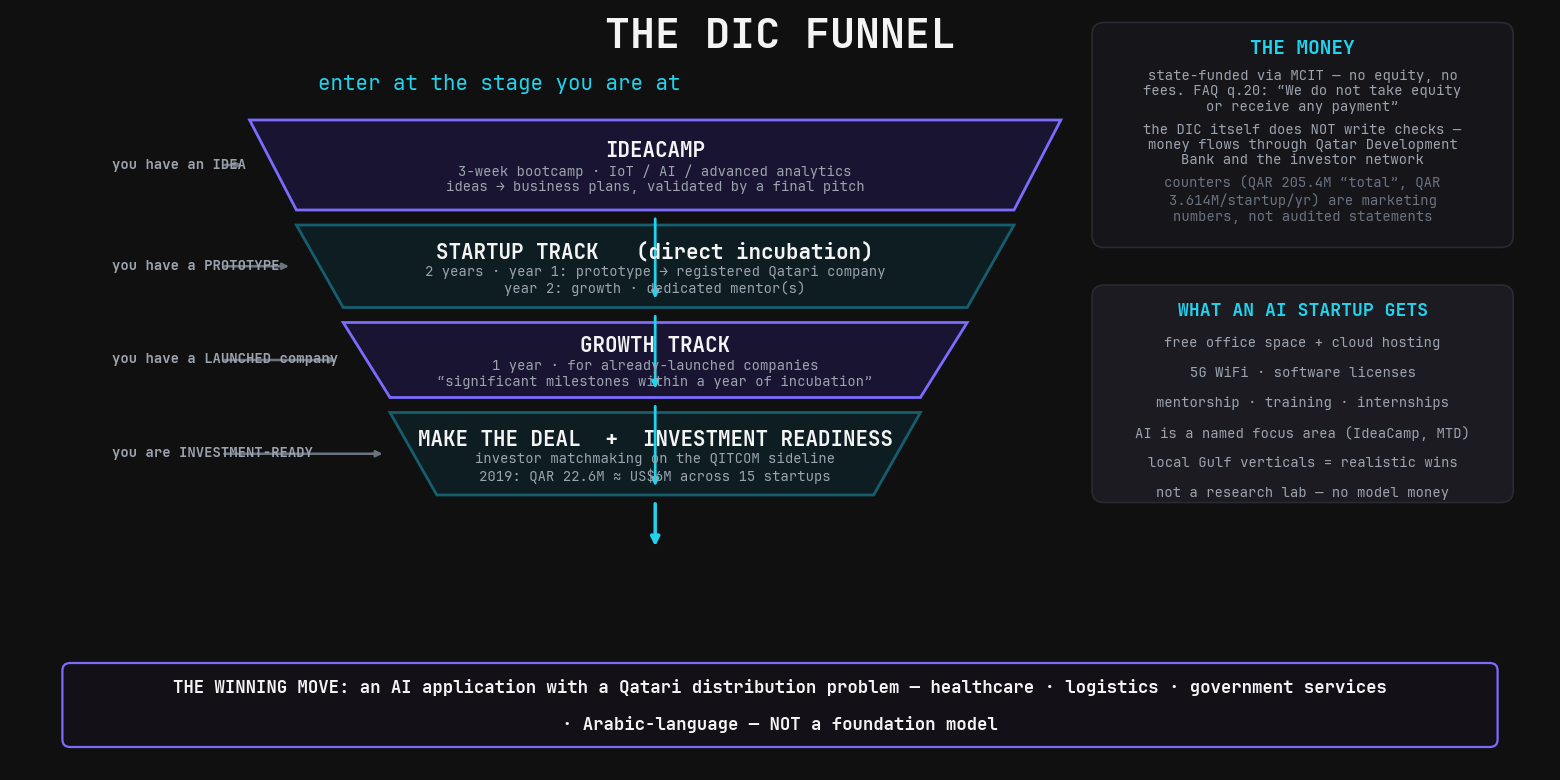
The DIC's own materials describe a funnel from idea to funded company: four core tracks plus two investment-readiness programs.
IdeaCamp — the entry point: a three-week bootcamp where entrepreneurs, developers, and designers turn tech ideas into validated business plans, ending in a final pitch. The named technology areas are exactly three: IoT, AI, and Advanced Analytics. Historic outcomes: 27 of 31 competing ideas were incubated in the January 2018 cohort; 25 startups came out of the second edition in 2019.
Direct Incubation (Startup Track) — two years for early-stage startups with a market-ready product or prototype: year one takes a startup from prototype to registered business in Qatar; year two is the Growth Track.
Growth Track — one year for businesses that have already launched, "positioning startups for accelerated growth."
Coworking Space — free hot desks, internet, and facilities for entrepreneurs and small businesses.
Make the Deal (MTD) — the investor-startup matchmaking event held on the sidelines of QITCOM, Qatar's annual ICT conference. Its own page names the target technologies explicitly, with "artificial intelligence" first among IoT, smart home, augmented reality, cybersecurity, and big data. In the 2019 edition, 228 startups pitched, 15 walked away with deals, and QAR 22.6 million (≈ US$6M) was committed by 110 investors. The top single deal was US$2M.
Angel Investor Bootcamp and Startup Investment Readiness Program — the two newest tracks, visible in the site's navigation from 2024 onward: the DIC increasingly positions itself on the funding side of the funnel, teaching founders how to take investment rather than just how to build products.
The funnel is explicit: IdeaCamp turns ideas into startups. Startup Track turns startups into registered companies. Growth Track scales them. Make the Deal connects them to money. You can enter at the stage you are at.
What an AI startup actually gets
From the DIC Services page, incubation provides training, dedicated mentorship (each company gets at least one mentor, sometimes two), networking, industry contacts, investor access, internships from Qatari universities — and free office space whose details matter for AI startups: cloud hosting, a 5G WiFi network, and software licenses are listed as included facilities. The relevant parts for an AI startup are the free cloud hosting and compute-adjacent infrastructure, the 5G connectivity (Qatar is an early and aggressive 5G market), and the investor matchmaking — because the DIC itself does not write checks.
AI is a named focus area
AI is written into the program materials, not incidental to them. IdeaCamp's technology areas are exactly IoT, AI, and Advanced Analytics; Make the Deal lists AI first among its emerging-technology focus areas; the Startup Track FAQ's preferred technologies lead with cloud computing, big data, and analytics. The portfolio reflects it — the 2023 and 2025 intake lists include Ellogy AI, Speechzy (AI/ML for speaking skills), Tahado (AI-based cervical cancer diagnosis from 3D scans), Ceena Lab / BizPlanner (AI-assisted business plan generation), Ferasah (machine-learning prediction of asset failure), and Sensorways (IoT + ML equipment monitoring).
The honest caveat: most of the portfolio is marketplaces, delivery apps, and vertical e-commerce — the classic Gulf SaaS pattern. The genuinely AI-first startups are a minority. You are not joining a DeepSeek or a Mistral; you are joining a state-backed incubator where the realistic winning category is an AI application with a Qatari distribution problem — healthcare, logistics, smart city, education — not a foundation model.
The market you are actually building for
Qatar has roughly 3 million people (World Bank, 2025: 2,972,215), of whom only a few hundred thousand are citizens. No startup in this program will scale on the domestic market alone; the DIC's real value is a zero-cost base inside a well-capitalized state with an open door to regional and international investors. The strategy that fits the market:
- Arabic-language AI is the open niche. The Gulf's Arabic-capable foundation models come from the neighbors — the UAE's TII Falcon, Saudi Arabia's SDAIA ALLaM — and Qatar ships no frontier Arabic model of its own. The opening is application-layer: Arabic-first products built on someone else's model, with a local distribution problem.
- The state is the anchor customer. TASMU Smart Qatar is a national program explicitly seeking smart solutions in healthcare, transport, and environment, and the government-services layer is where Digital Agenda 2030 money flows.
- The talent pool is thin, so plan to import. QCRI/HBKU graduates are the local edge; most engineering hires will come from abroad — which the DIC's residency rule (no citizenship, no Qatari partner required) accommodates.
- Use Doha as the beachhead, not the destination. Web Summit Qatar has run in Doha since February 2024, and QITCOM carries the investor matchmaking; both are exposure channels into the wider GCC. The winning pattern: pilot with a Qatari government or enterprise customer, prove it in a small rich market, then export across the Gulf.
The money question
Three facts define the economics:
- Zero equity, zero fees. FAQ question 20, verbatim: "No, DIC is a government-funded program. We do not take equity or receive any payment in return for our services." This is the whole point of the "0% Equity. 100% Enablement." rebrand.
- DIC does not directly fund startups. FAQ question 5: "potential funding is available through the Qatar Development Bank and other financial institutions." The DIC is a connector, not a fund; the money comes through QDB and the investor network built around events like Make the Deal.
- The numbers are real but modest. QAR 22.6M (≈ US$6M) across 15 startups in the best-documented Make the Deal edition (2019); QITCOM-adjacent awards pay in the QR 25,000–125,000 range. This is early-stage, incubation-scale money — enough to build and pilot, not enough to fund a frontier-lab compute bill.
Who can apply
- Residency in Qatar is the requirement — "any innovative entrepreneur with residency in Qatar." No Qatari citizenship and no Qatari partner needed.
- Idea-stage is fine. No product required to enter the pipeline; that is what IdeaCamp is for.
- Existing startups are fine. Companies with a product already launched enter the Startup Track at the appropriate stage.
- Applications are accepted year-round, with the Startup Track process taking up to three months.
- Evaluation criteria (FAQ question 10): original idea in a focus area, market opportunity, target customers and validation, initial cost structure and financial plan, team profile.
The application form asks the one question that matters: "If you require funding, please estimate the amount, and how you would use the funding."
The Qatar AI context
The DIC sits inside a state that has spent the last half-decade positioning itself as the Gulf's neutral, well-capitalized AI hub: the 2019 National AI Strategy made AI an explicit national priority; Digital Agenda 2030 is MCIT's umbrella for the digital transformation, with the DIC as the startup-facing layer; Web Summit Qatar has run in Doha since February 2024, bringing international investors to the market. Around the DIC sit the Qatar Development Bank (funding), QBIC (explicitly named as a collaborator in the DIC's FAQ), Bedaya, Qatar University, and the research layer of QCRI at HBKU with its Qatar Center for AI (QCAI).
The strategic logic of the zero-equity model: the state wants technology companies formed and staying in Qatar, so it underwrites the incubation cost rather than taking a stake. For a founder, that is the best possible terms sheet — provided you actually want to build for the Qatari market.
Bottom line
The DIC is a real, well-documented, zero-equity incubator that names AI among its focus areas, offers free office space with cloud hosting and 5G, and funnels startups toward Qatari money through the Qatar Development Bank and its own investor matchmaking. For an AI startup willing to build for the Qatari market — healthcare, logistics, education, government services, Arabic-language applications — the terms are genuinely good.
Keep the frame honest: this is a local-market incubator with an AI label and excellent terms, not a research lab. The winning move is an AI application with a Qatari distribution problem to solve — Arabic-language and vertical applications, not foundation models and not consumer scale.
References:
- DIC homepage (Wayback, 27 Mar 2023) — mission, stats counters, program tracks, startup lists.
- DIC homepage (Wayback, 29 May 2025) — "0% Equity. 100% Enablement", current program descriptions, 2025 intake list including Ellogy AI.
- Startup Track page with full FAQ (Wayback, 10 Jun 2023) — eligibility, evaluation criteria, no-equity policy, Qatar Development Bank funding, application process.
- IdeaCamp page (Wayback, 10 Jun 2023) — technology areas (IoT, AI, Advanced Analytics), workshop schedule.
- DIC Services (Wayback, 9 Jun 2023) — training, mentorship, networking, investors, office space (cloud hosting, 5G WiFi, software licenses).
- Make the Deal (Wayback, 10 Jun 2023) — AI among focus technologies, matchmaking format.
- Over $6 million invested into tech startups at QITCOM (Wayback, 10 Jun 2023) — QAR 22.6M / US$6M, 228 startups, 15 winners, investor names.
- MoTC Announces Winners of Entrepreneurship Zone Awards (Wayback, 10 Jun 2023) — QITCOM 2019 awards and cash prizes.
- 27 New Ideas Win Incubation (Wayback, 10 Jun 2023) — 2018 cohort outcome.
- Digital Incubation Center to Welcome First Intake for 2016 (Wayback, 10 Jun 2023) — founding-era framing and service list.
- Qatar population, World Bank Open Data — 2,972,215 (2025).
- Qatar Center for Artificial Intelligence (QCAI) — QCRI's AI center: foundations & systems, precision health, social good.
- Qatar Computing Research Institute (QCRI) — the research layer for AI and Arabic NLP at HBKU.
- TASMU Smart Qatar — national smart-solutions program (healthcare, transport, environment).
- Falcon LLM (TII, UAE) — the Gulf's open Arabic-capable foundation model.
- Qatar — National AI Strategy (2019) — national AI strategy context.
- Related: The UAE's Human Stack — the neighbor's education-first sovereign AI play; Hangzhou AI City — the exception that proves the dependency-stack rule; AI Sovereignty Is Freedom.