This post has been consolidated into Harness Engineering: Best Practices for Reliable Agent Systems. See that canonical post for the full, merged guidance. Task harnesses are the scaffolding that turn a high-level engineering question—"Can this system finish a real task?"—into reproducible, debuggable experiments. This post explains what "Task Harness Engineering" means, how it differs from Eval harnesses (benchmarks) and Agent harnesses (integration + environment tests), and practical recommendations for building one.
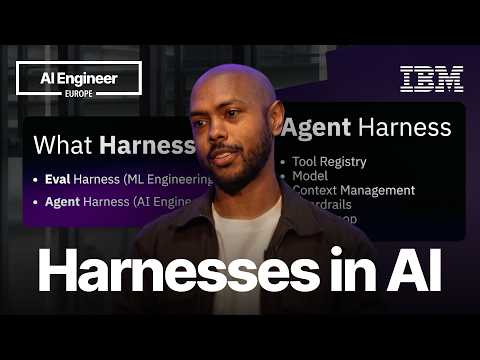
Source: Harness Engineering (YouTube), referenced for conceptual framing and examples (video id: C_GG5g38vLU).
What is a harness?
- A harness is code and infra that runs a task, measures outcomes, and records what happened. Harnesses range from small unit-test-like runners to complex environment orchestrators that start services, browsers, or VM sandboxes.
Task Harness Engineering
- Goal: exercise an agent or system with realistic tasks that capture the operational surface area you care about.
- Characteristics: stateful, often non-deterministic, reliant on external systems or realistic mocks, and focused on end-to-end success rather than a single scalar metric.
- Example tasks: finish a multi-step research workflow, triage a bug in a real repo, navigate a web app and complete a purchase flow, or orchestrate tools to solve a programming prompt with tests.
- Measurements: success/failure, retries, time-to-completion, observability traces, logs, and qualitative artifacts (replays/screenshots).
Eval Harness (what it is and how it’s different)
- Eval harnesses run static, dataset-driven evaluations (datasets, metrics, automated scorers).
- Characteristics: deterministic or quasi-deterministic, high throughput, designed to compute reproducible aggregates (accuracy, F1, BLEU, etc.).
- Strengths: clear comparisons, statistical rigor, fast iteration.
- Weaknesses vs Task Harness: lower realism (benchmarks are proxies), brittle to specification differences, and limited visibility into long-horizon or environment-level failures.
Agent Harness (what it is and how it’s different)
- Agent harnesses focus on agents interacting with environments (simulated worlds, browsers, shells, APIs) and on integration points: tool calls, state persistence, safety checks.
- Characteristics: emphasizes sandboxing, step-level instrumentation, and emergent behaviors across many steps.
- Overlap with Task Harness: agent harnesses are often the runtime that executes task harnesses when the subject is an agent; agent harnesses add concerns like action validation, safety guards, and tool interfaces.
Key axes of difference
- Realism: Task >> Eval. Agent harness sits between and often provides the runtime for tasks that exercise agents.
- Determinism: Eval (high) > Agent (medium) > Task (low).
- Metrics: Eval focuses on aggregated scalars; Task harnesses capture a richer set (end-to-end success, observability, human judgments). Agent harnesses must capture both step-level and end-to-end signals.
- Infrastructure: Task harnesses require orchestration of real or high-fidelity mocks (browsers, CLIs, repos). Eval harnesses only need fast scoring pipelines. Agent harnesses require safe sandboxes and tool shims.
Practical engineering patterns
- Instrumentation-first: log inputs, decisions, tool calls, and environment responses. Design for replay.
- Replayability: capture transcripts and environment snapshots so failed runs can be replayed deterministically when possible.
- Tasks that "fight back": design tasks that surface edge cases, race conditions, and adversarial inputs instead of only happy paths.
- Hybrid approach: use eval harnesses for fast filtering, then escalate promising models to task harnesses for realism tests, and run agent harnesses in parallel to validate tool integrations.
- Isolation and safety: run untrusted code in sandboxes; for web/OS interaction prefer ephemeral VMs/containers and recorded interactions.
- Observability and triage: attach lightweight traces (request ids, timestamps) to link model internals to external failures.
When to use each harness
- Use Eval harness when you need fast, repeatable comparisons during model iteration.
- Use Task harness when your priority is real-world behavior, end-to-end failure modes, or human-facing UX outcomes.
- Use Agent harness when validating tool use, stateful interactions, or safety boundaries across many steps.
Conclusion and recommendations
Task Harness Engineering complements, not replaces, eval and agent harnesses. The right pipeline uses them together: evaluate cheaply, validate realistically, and instrument deeply. Start with a minimal task harness for the most critical user journeys, make reproducible recordings, and iterate: increase realism until the harness meaningfully predicts production failure modes.
Notes and references
- Video source (conceptual reference): https://www.youtube.com/watch?v=C_GG5g38vLU (video id: C_GG5g38vLU)
- Encourage readers to run the referenced talk for additional context and examples.
Engineering is the application of knowledge to solve problems within constraints. The constraint here is the central fact. Understanding the constraint is understanding the problem. The solution follows from the constraint. This is the engineering method: name the constraint, design within it, verify the design works.
A task harness is not a benchmark. It is a specification. The specification defines what success means. Without it, the agent is optimizing for a proxy that may not capture what you actually want.